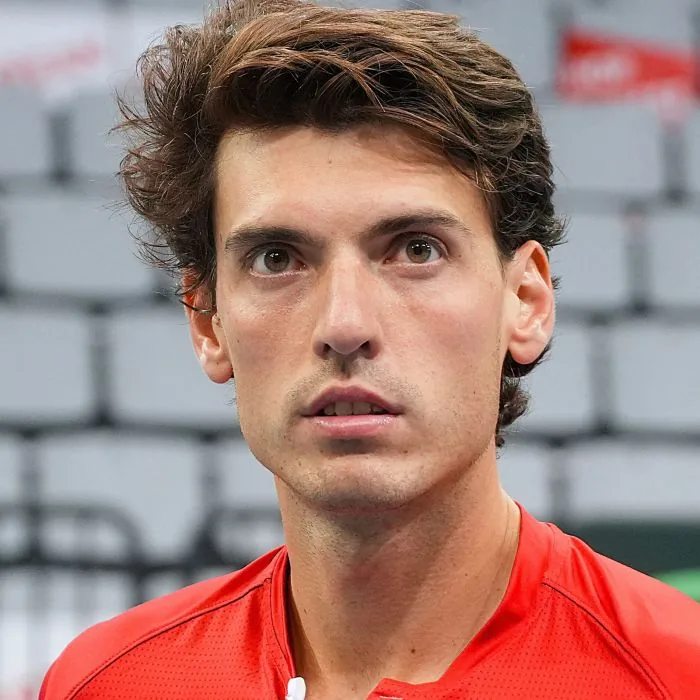







Head-to-Head
The direct matchup history between Raphael Perot and Stefan Kozlov remains limited at the professional level, which is typical for players competing primarily on the Challenger circuit. However, Kozlov’s experience competing against similar profiles—aggressive baseline players with inconsistent serve mechanics—suggests he has developed effective counter-strategies. Perot’s game relies heavily on power and court positioning, but lacks the consistency that characterizes Kozlov’s methodical approach.
Read more Rodesch Favored Against Agamenone in ATP Challenger Clash
When examining comparable opponents, Kozlov has demonstrated superior performance against players who depend on aggressive shot-making without reliable serve support. This pattern indicates that Kozlov’s defensive positioning and return-of-serve strength create structural problems for Perot’s tactical approach. The absence of a significant head-to-head record actually favors the more experienced and consistent player—Kozlov—who has faced a broader range of competitive styles.
Form Guide
Stefan Kozlov enters this match as the more reliable performer on the Challenger circuit. His recent tournament appearances show consistent progression through qualifying rounds and main draw matches, with particular strength in extended rallies where his court coverage becomes decisive. Kozlov’s serve, while not explosive, maintains consistency above 60% first-serve percentage—a critical metric for holding serve against aggressive returners like Perot.
Raphael Perot’s recent form reveals the volatility that characterizes his game. While capable of producing dominant performances in individual sets, his match consistency remains problematic. His serve percentage fluctuates significantly depending on match pressure, and his break-point conversion rate against quality opponents hovers around 25-30%. This inconsistency becomes magnified against opponents who can neutralize his power through solid defensive positioning—precisely Kozlov’s strength.
Neither player carries reported injury concerns heading into this fixture. Both are competing at their natural level on the Challenger circuit, though Kozlov’s tournament scheduling suggests better match rhythm and accumulated court time in recent weeks.
Key Factors
The Mexico City altitude (2,250 meters) creates a significant tactical variable. The thin air reduces ball deceleration, which theoretically benefits aggressive players like Perot. However, this same condition also extends rallies by reducing spin effectiveness—a scenario where Kozlov’s consistency and court positioning provide structural advantage. Players who rely on precision and movement typically outperform power-dependent competitors in high-altitude conditions once the initial adjustment period passes.
Read more Berrettini’s Clay Credentials Test Bautista Agut’s Consistency at Monte Carlo
Serve-and-volley opportunities will be limited for both players on the hard court surface. The match will likely be decided in baseline exchanges, where Kozlov’s superior footwork and return-of-serve mechanics create pressure. Perot must win the first-set tiebreak or establish an early service break to control match tempo; failure to do so typically results in Kozlov’s methodical approach wearing down his opponent across three sets.
Three critical triggers could shift the outcome: (1) If Perot’s first serve exceeds 65% and he wins 40%+ of break points, he gains genuine winning chances; (2) If Kozlov’s return-of-serve drops below 30% effectiveness, Perot’s power becomes overwhelming; (3) If either player suffers an early injury or visible fatigue, the match dynamics reverse entirely. Currently, none of these conditions appear probable based on recent performance data.
Our Verdict
Kozlov’s superiority in this matchup stems from structural advantages rather than marginal differences. His consistency in serve percentage, return-of-serve effectiveness, and baseline court positioning create a tactical framework that neutralizes Perot’s primary weapons. The altitude factor, while potentially beneficial to aggressive players, actually favors extended baseline rallies—Kozlov’s domain. Perot would need to execute a near-perfect performance, maintaining serve holds and converting break opportunities at rates significantly above his recent averages.
The market pricing reflects this reality accurately. Kozlov’s odds of 1.61 represent fair value for a player with clear structural advantages in this specific matchup. Perot at 2.18 carries value only
Read more Hurkacz Favored to Overcome Rising Darderi at Monte Carlo Masters