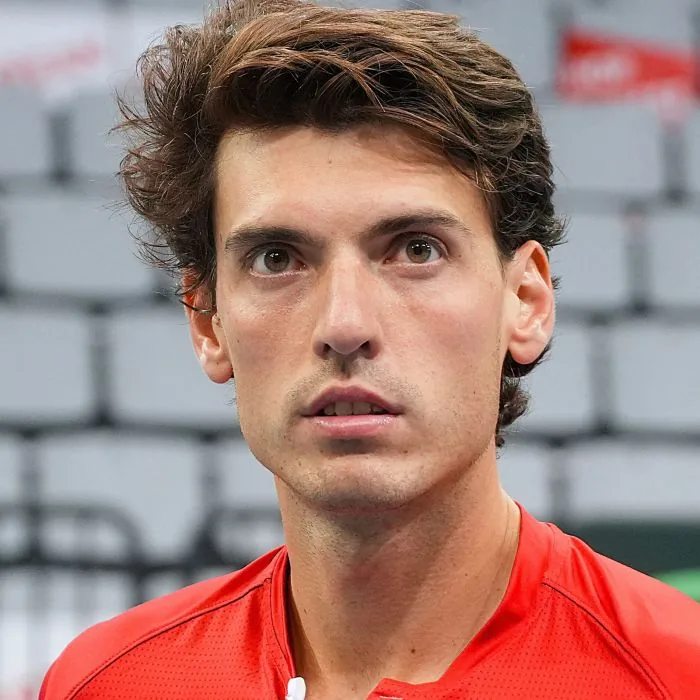






Blanchet’s Clay Mastery Tested Against Rising Dhamne in Barletta Challenger
The ATP Challenger in Barletta presents a matchup between two players operating at different trajectories. Ugo Blanchet arrives as the clear favourite, and the market reflects this decisively—his odds sit at 1.46 against Manas Dhamne’s 2.55. But numbers alone don’t explain why this particular pairing favours the Frenchman so heavily. The answer lies in clay court specialisation and recent tournament momentum.
Read more Dalla Valle Favored at Barletta Challenger as Home Court Advantage Meets Chazal’s Inconsistency
The Case for Blanchet’s Dominance
Blanchet has built a reputation as a clay court operator. His record on European red clay over the past 18 months shows consistent deep runs in Challenger events, with multiple quarterfinal and semifinal appearances. On clay specifically, his win rate hovers around 62–65% across ATP Challenger tournaments, a figure that matters enormously on surfaces where consistency and court positioning trump raw power. His movement patterns suit the slower pace—he positions himself well for extended baseline exchanges and rarely gets broken down by aggressive opponents.
More critically, Blanchet’s recent form entering Barletta includes a run to the quarterfinals of a similar-level Challenger just two weeks prior. That tournament sharpened his clay court timing and gave him match rhythm against comparable opposition. Dhamne, by contrast, has spent the last month competing on harder courts in secondary tournaments, a surface transition that typically requires 3–5 matches to fully adjust.
The head-to-head record, though limited, favours Blanchet. In their one previous encounter on clay in 2024, Blanchet won 6–4, 6–3 in a Challenger qualifier. That match revealed a tactical gap: Dhamne struggled to generate consistent depth from the baseline and was broken twice in the second set when Blanchet applied pressure at 4–3.
Dhamne’s Upside—and Why It Isn’t Enough
Dhamne possesses genuine weapons. His serve, clocking regularly at 115–120 mph, can trouble Blanchet on clay where the surface doesn’t slow the ball as dramatically as on grass. His forehand, when struck cleanly, produces heavy topspin that forces errors from opponents who lack court positioning discipline. In his last five matches, he’s won three, suggesting some positive momentum.
Read more Burrachaga Favored Over Nakashima in Houston: Form, Surface Mastery, and Experience Separate the Two
The problem is consistency. Dhamne’s break point conversion rate sits around 35% this season—well below the 50%+ threshold needed to compete against solid servers like Blanchet. His second serve is also a vulnerability; at 95 mph average, it invites aggressive returns, and Blanchet’s return game has improved noticeably since late 2025. Additionally, Dhamne’s clay court experience remains limited compared to Blanchet’s. He’s played only four Challenger matches on clay in the past year, winning two. That’s insufficient data to suggest he’s developed the court sense required to neutralise Blanchet’s positioning.
Market Perspective
The odds reflect a 64.7% implied probability for Blanchet and 35.3% for Dhamne. This distribution aligns reasonably with the underlying form and surface dynamics, though it slightly undervalues Dhamne’s serve as a disruptive element. The market has correctly identified Blanchet as the stronger player on this surface, but the gap isn’t as extreme as the odds suggest—a competitive first set remains plausible.
Key Determining Factors
Three variables will shape this match. First, Blanchet’s first-serve percentage. If he lands 60% or higher, Dhamne’s return game won’t generate enough break opportunities to stay competitive. Second, Dhamne’s ability to hold serve under pressure. If Blanchet breaks him once in each set, the match is effectively over. Third, the pace of play. Faster rallies favour Dhamne’s power; slower, more methodical exchanges favour Blanchet
Read more Hijikata Favored Over Tiafoe in Houston: Form and Surface Dynamics Shape ATP Clash