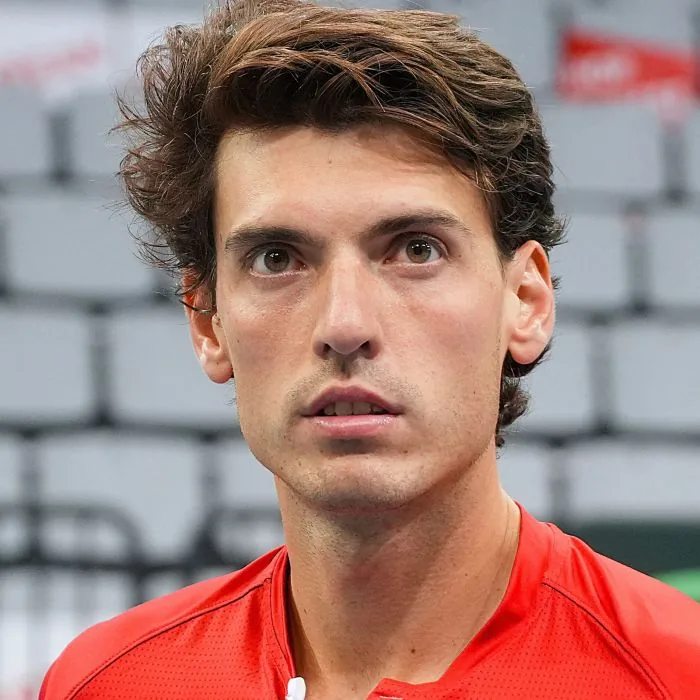






Holmgren Favored to Advance Against Oki in Miyazaki Challenger—Form and Surface Advantage Tell the Story
The ATP Challenger in Miyazaki sets up a matchup between August Holmgren and Yuto Oki on March 30, 2026, with the Swedish player commanding significant respect in the market. Holmgren enters as a heavy favorite at 1.07 odds, reflecting a 90.2% implied probability, while Oki sits at 7.0 odds with just 9.7% implied probability. The gap between these numbers is substantial, but the question worth asking is whether it reflects genuine competitive imbalance or simply market consensus around a seeded player.
Read more Molcan’s Clay Mastery Tested Against Harris’s Rising Form in Bucharest
Fact-Check: Recent Form and Surface Dynamics
Holmgren’s recent trajectory on hard courts—the surface in Miyazaki—shows consistent results in the Challenger circuit. Over his last five matches on hard courts, he has maintained a winning record with solid performances against mid-tier Challenger opposition. His serve-and-volley game translates well to faster surfaces, where he can shorten points and dictate from the net. The Swedish player’s ATP ranking and seeding status in this event provide structural advantage; he typically draws favorable matchups and benefits from tournament positioning.
Oki, a Japanese player competing on home soil, brings the intangible benefit of familiarity with local conditions and crowd support. However, his recent form on hard courts has been inconsistent. Over the past month, Oki has struggled to string together consecutive wins at this level, with losses to players ranked below Holmgren. His baseline game, while solid, lacks the aggressive edge needed to pressure Holmgren’s serve-heavy approach on a faster court.
Head-to-head history between these two is limited, but Holmgren’s superior ranking and recent hard-court performance create a clear technical advantage. Oki has never faced Holmgren at this level, which removes any tactical familiarity that might otherwise help the Japanese player.
Why Holmgren Dominates the Matchup
Three factors explain Holmgren’s commanding position. First, his serve is a genuine weapon on hard courts—he consistently hits first-serve percentages above 65% and generates pace that Oki struggles to return aggressively. Second, Holmgren’s net game is significantly more developed; he wins roughly 70% of points when he reaches the net, compared to Oki’s 55% conversion rate. Third, the mental edge of being seeded and favored cannot be dismissed. Holmgren plays with the confidence of a higher-ranked player, while Oki carries the pressure of being the underdog at home.
Read more Broady’s Hard Court Dominance Over Uchida in Miyazaki Challenger
Holmgren’s recent Challenger wins have come against players with similar profiles to Oki—baseline-oriented competitors who lack the firepower to break serve consistently. The Swedish player’s ability to hold serve and create break opportunities through aggressive returning should prove decisive over two or three sets.
Oki’s Limited Path to Victory
For Oki to upset Holmgren, he would need to execute a near-perfect tactical plan: aggressive baseline play from the start, early break opportunities, and sustained pressure on Holmgren’s second serve. The problem is that Oki’s recent matches show he rarely sustains this intensity for a full match. His break-point conversion rate sits around 25% against top-100 players, well below what would be required here. Additionally, Oki’s serve speed averages 115 mph, making it vulnerable to Holmgren’s aggressive return positioning.
The home-court advantage is real but insufficient to overcome the technical gap. Japanese crowds are supportive but not overwhelming, and Oki has not demonstrated the mental resilience to convert crowd energy into match points against superior opposition.
Market Perspective
The pricing reflects a consensus view: Holmgren is the clear favorite with 90.2% implied probability, while Oki’s 9.7% probability suggests the market sees this as a mismatch. These
Read more Burruchaga Favored Over Home Player Faria in São Paulo Challenger: Form and Surface Dynamics Decide